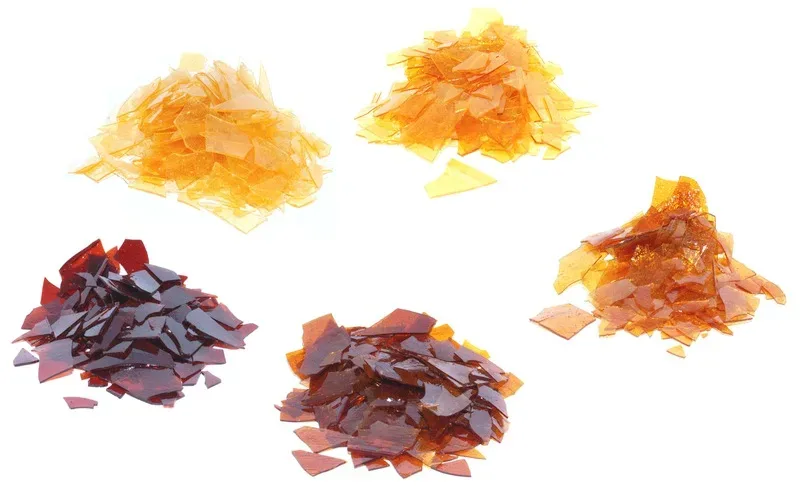
Probably my favorite finish is shellac because of it’s versatility. Shellac is one of the oldest clear finishes and is a natural finish – made from the secretions of the “laq” bug. Despite it’s name shellac and lacquer are not related finishes. Lacquer is a synthetic resin.
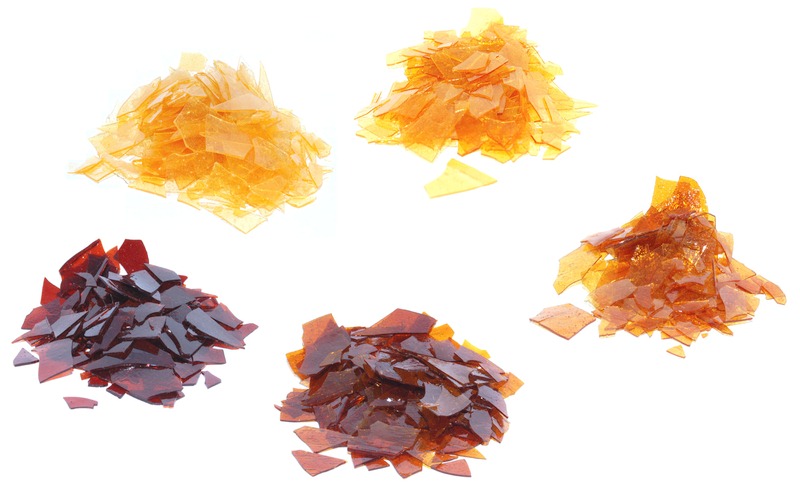
Clear shellac comes in clear and amber (referred to as “orange”) versions as well as a special “de-waxed” version in which the natural occurring is removed so that it can be recoated with a greater variety of finishes. Shellac, of course, comes in a white-pigmented version which is commonly used as a primer (Zinsser’s BIN is an example of such a product).
Shellac as a washcoat
A “wash” is a term used to specify a thin coat of shellac. A shellac wash coat is used as a pre-stain conditioner to prevent over-absorption of stains in porous wood (like plywood or veneers). Wash coats of shellac are used as an isolating barrier between layers of faux finish glazes. A wash coat of shellac would be approximately 1 part shellac to 2 parts of alcohol.
Tinitable with Universal Colorants
Clear shellac can be tinted with universal colorants to achieve other colors. (See Zinsser chart for greater detail on tinting). Extra shaking time is usually needed with universal tints to disperse the tint properly. Tinted clear shellac can be used as a “toning” finish or as a base coat under oil paint / glaze faux finishes (like marbling), black shellac makes a great base coat for marbling, as does white (BIN).
Read Also:
Orange or Clear
Orange or amber shellac is the natural color of shellac. Orange shellac is used with dark woods to give a warmer look to the woods. Orange shellac is the common “knot sealer” used to spot prime wood knots to prevent resin bleed from the knot.
Clear or bleached shellac is by far the most commonly used shellac for wood finishing. Clear shellac is pretty close to “water white” or clear with only the slightest golden cast to it. Keeping the coats thin will minimize any shading imparted by the use of clear shellac. One of the benefits of shellac is that it does not yellow with age as does oil-based varnishes or polyurethane.
Advantages of Shellac as a clear finish
Shellac will not re-wet an oil-based stain as will an oil-based varnish. For this reason, shellac is commonly used as a “sealer” over wood stain before varnishing. Another reason shellac is used as a first coat over wood stain is it is quickly recoatable (about 30 minutes) and it is not re-softened by over-coating with varnish. Shellac also melts into itself without sanding.
There is no need to sand between coats of shellac for proper intercoat adhesion. A very smart method of wood finishing will lay down two coats of shellac as a fast dry sealer before sanding and finishing with an oil varnish – this helps to ensure that the sanding will not sand through the shellac and remove the underlying stain
Shellac can be used as a Final Finish Coat
A strength and a weakness of shellac is that it is reversible/dissolvable with a fairly common solvent – alcohol. Because alcohol is used in some household cleaning solutions a shellac finish can be damaged with these types of cleaners. Shellac is also susceptible to water spotting.
If water is left standing of shellac repeatedly or for long periods the water will cause white spotting of the shellac finish. For the reasons mentioned above shellac is commonly limited to a sealer before a final coat or varnish – which does not have the same shortcomings as shellac as it relates to alcohol and water sensitivity.
Having said that, shellac can be used as a finish coat if you understand it’s weaknesses and avoid the use of cleaners that contain alcohol. Used on vertical surfaces usually doesn’t pose a problem with water spotting.
Shellac is Often Repairable Without Refinishing
If you do get water spotting with shellac or if the finish gets damaged, you can often repair it and remove the white spotting by wiping the finish with a rag dampened with denatured alcohol.
Dewaxed Shellac
As a rule, you can only recoat clear shellac with shellac or oil-based varnish. Polyurethane and water-based finishes do not adhere well to shellac because of a naturally occurring wax in the finish. To remedy this problem, manufacturers have developed a process to remove this wax to make recoating possible with other clear finishes. Zinsser has a dewaxed shellac product that they call “Seal Coat” which is recoatable with a variety of clear finishes including oil-base and water-base polyurethane, lacquer, and shellac.
Clean Up
Another nice property of shellac is that it will clean up with ammonia and water and a water rinse. You don’t need to use strong solvents to clean your brushes as with oil-based finishes and polyurethane.
Old Shellac
As shellac ages, it eventually becomes non-drying. Never use old shellac. Zinsser prints the date of manufacture on the can of their Bullseye shellac and guarantees proper drying for three years from that date. Buy your shellac in quantities for your immediate needs only and you should be able to avoid any problems with old shellac.