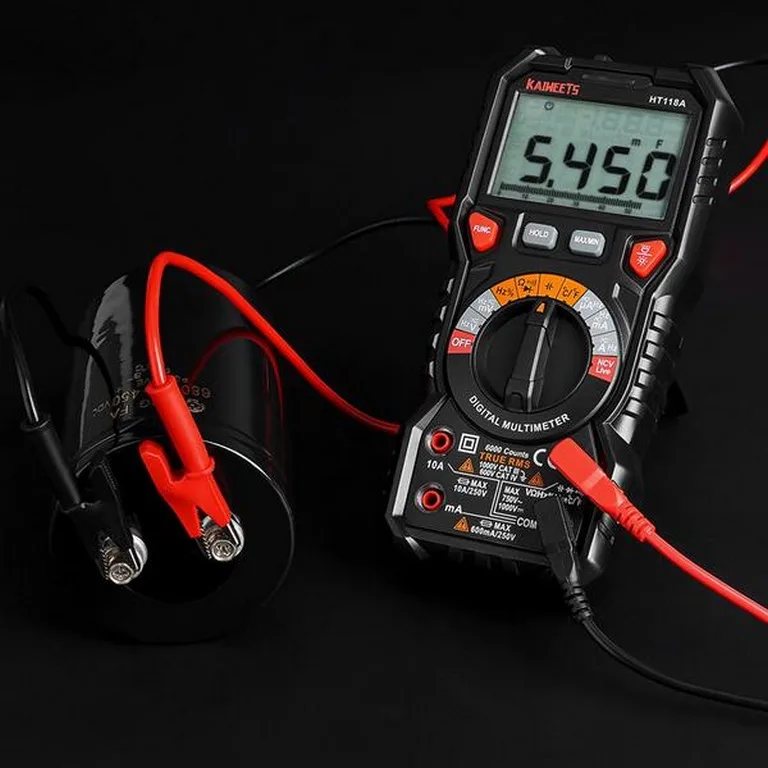
A multimeter is indispensable for measuring electrical quantities. But which one to take when they all look so alike? Analog, digital, or with a needle display? I think this guide will help you make the right choice.
The multimeter is a device that measures various electrical quantities. Its main task is to protect you against electrical hazards, such as electric shock, by ensuring that work is not carried out under voltage.
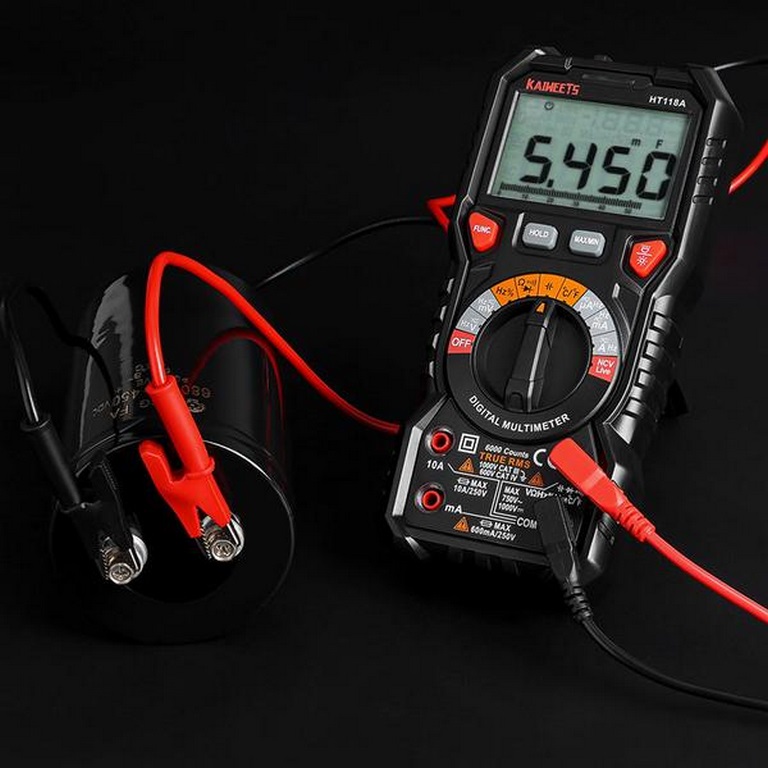
The voltage is given in V (volts). All multimeters have this function, which corresponds to the voltmeter mode. This function also enables faults, breakdowns, and irregularities in an electrical circuit to be detected.
Multimeters can also test electrical continuity. This is the ohmmeter mode, which enables the resistance value measured in Ω (ohms) between two points to be displayed.
The devices are often equipped with a buzzer so that a signal sounds when the resistance is very low or zero and the current flows through unhindered. Many of the newer multimeters are equipped with additional functions that allow more specific use.
This includes the measurement:
- Of the stream,
- The impedance (resistance of coils),
- The capacity (charging voltage of capacitors) and
- The power (coupling of a voltmeter and an ampere current clamp).
Even if multimeters look similar, you should pay attention to their various functions. The various options also influence the price of the device.
1. Analog Multimeter
Analog multimeters can be recognized at first glance with their needle displays. The various scales allow the measured value to be read off. The value is read on the scale of the selected mode. The analog technology is precise and safe. It has proven itself for decades.
2. Digital Multimeter
Unlike the analog multimeters, the digital models do not have a needle display, but a display. The measured value is displayed directly. Digital or smart multimeters work with the help of an analog-to-digital converter, which simplifies the selection of the mode and the reading of the measured value.
Thanks to their easy handling and the fact that they can be waterproof, shockproof, and cheaper, they are gradually replacing analog multimeters.
Depending on whether you only occasionally use your multimeter for DIY purposes or use it every day for business, you will have different requirements about the various measuring functions, the display, and the measuring accuracy. Here are the most important functions for each application at a glance.
Read Also:
Occasional Use and Home Improvement
From simply changing a lightbulb, connecting electrical sockets, testing rechargeable batteries and batteries, or discovering malfunctions in control panels. In these cases, a simple multimeter is perfectly adequate.
The voltmeter and ohmmeter modes allow you to perform this work and check the presence or absence of electrical voltage. Opt for a device with a large measuring range (200 mV – 200 V direct current (DC) and 0 – 600 V alternating current (AC)).
It is suitable for most uses. The ohmmeter function covers all resistances from 0 (continuity test) to 2 MΩ. Choose when in doubt they prefer simple to use the device with a limited number of nominal areas (analog or digital) from.
Regular Use
Do you regularly work on power grids or electrical systems, wire switch boxes or devices, or do simple troubleshooting? To do this, you need a more powerful, reliable multimeter that has additional functions.
Choose a device that, unlike the classic ohm or voltmeter, also measures the current (in A for amperes). For the sake of simplicity, choose a “fork” or “current clamp” type multimeter.
It allows you to take your measurements without having to disconnect any cables or prepare the system beforehand. The measuring ranges (10 A DC / 200 A AC) will cover all your requirements. A digital multimeter makes it easier to measure and read the measured values.
Intense or Professional Use
Are you a professional electrician or do you have a solid knowledge of electrics and assemble systems from A to Z? Do you work with industrial voltages (over 230 V and/or three-phase) and do you regularly repair devices and electrical machines?
In these cases, you need a high-quality multimeter that is equipped with functions and measuring ranges that meet your requirements. For voltmeter mode, choose a model that covers measurements with a direct current of 200 V in the continuity test and with an alternating current of 1000 V.
For the ampere function, use a model with terminals that covers 10 A DC in the direct current range and 400 A in the alternating current range.
The modes “Capacity” (in F for Farad) for the capacitors, “Impedance” (Ω for Ohm) for the coils, and “Wattmeter” (W for Watt) for calculating power are very useful for troubleshooting. For this application profile, a KM601 digital multimeter is the device of your choice.
Are you spoiled for choice between different multimeters that you like but can’t decide? In this case, consider the following criteria:
1. The Accuracy
This is the difference between the real value and the value given by the device. The smaller this value, the higher the measurement accuracy.
2. The Resolution
For two identical measurements, the resolution is the difference between the two values measured by the multimeter. The smaller the resolution, the higher the measurement accuracy.
3. The Effective Value
The multimeter can be:
- RMS multimeter (Root Mean Square = root mean square value or mean value of a non-linear value) is ideal for measuring through currents;
- Or TRMS multimeter (True RMS = real effective value) ideal for measuring alternative currents.
4. The Protection
This is the input protection for cable measurements (generally one or more fuses). High-quality models also have reverse polarity and/or overload protection.
5. The Norm and Category
All multimeters must meet the requirements of the low-voltage directive IEC 61010-1. According to the IEC 61010-1 standard, different security areas are defined in categories CAT I to CAT IV. Within this standard, all measuring devices are divided into these categories based on their application and performance:
- CAT I: Measurements on circuits that have no direct connection to the network (battery operation), e.g. B. Protection class 3 devices (operation with safety extra-low voltage), battery-operated devices, conventional car electrics.
- CAT II: Measurements on circuits that have a direct connection to the low-voltage network using a plug, e.g. B. household appliances, portable electrical appliances.
- CAT III: measurements at the source of the low voltage installation (meter, main connection, primary overcurrent protection), e.g. B. meters, low-voltage overhead lines, house connection boxes.
Electricity is dangerous. It picks, it burns, it kills! You will not be safe from an accident just because you have purchased a high-performance measuring device. Be sure to use it safely.
Check each time that you have turned on the correct mode. Pay special attention to your test leads: The sockets must always be clean and dry, and the cables must not be stripped or cut at any point. Remember that you don’t become an electrician just because you bought the electrician’s tools!