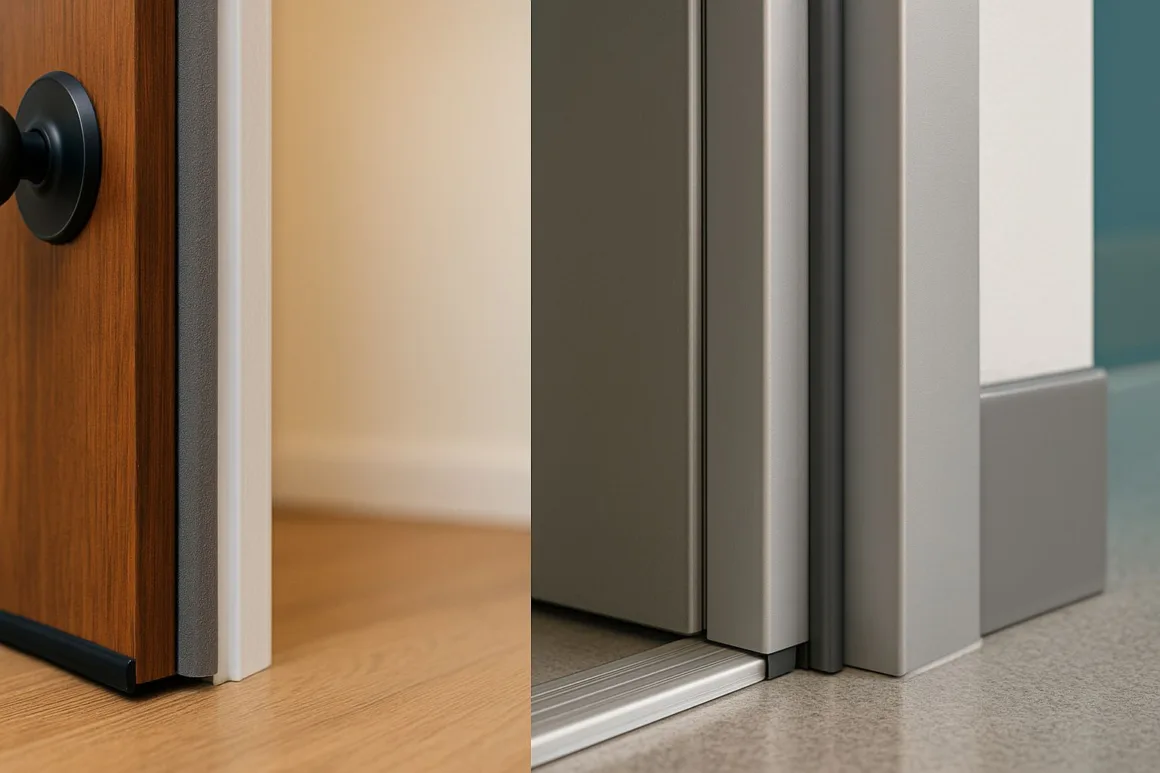
Not all door “seals” do the same job. This guide compares door gasketing vs weatherstripping so you know when simple weatherstripping is enough—and when code-compliant door gasketing (perimeter gaskets + an automatic door bottom) is required. Weatherstripping cuts drafts and moisture for comfort and energy savings; door gasketing controls air/smoke leakage and improves sound isolation for smoke/fire doors.
Quick reference: For a concise third-party comparison, see door gasketing vs weatherstripping.
Key Takeaways (Quick Wins)
- Weatherstripping is the budget-friendly seal for drafts and moisture on typical exterior doors/windows—great for DIY and energy savings.
- Door gasketing is a performance system (perimeter seals, automatic door bottoms, meeting-stile seals) for smoke/sound control and code compliance—common in commercial settings and high-performance homes.
- Code cues: ADA threshold heights (new work ≤ 1/2″, beveled), smoke/draft doors often limited to 3 cfm/ft² air leakage (UL 1784), and annual fire-door inspections per NFPA 80.
At a Glance: Door Gasketing vs Weatherstripping (Quick Chart)
| Feature | Door Gasketing | Weatherstripping |
|---|---|---|
| Primary job | Control air/smoke, improve acoustics, support fire/egress performance | Reduce drafts and moisture for comfort and energy savings |
| Typical components | Perimeter seals, automatic door bottoms, meeting-stile seals | Foam/felt tape, V-strips, bulb/fin gaskets, door sweeps |
| Where used | Commercial, healthcare, schools; high-performance residential | Residential doors/windows; light commercial |
| Standards | Often tied to UL 1784 (smoke), NFPA 80/105 (fire/smoke) | Energy-efficiency guidance and product labeling |
| Install skill | Trade-pro or advanced DIY; clearances/templates matter | DIY-friendly |
| Durability | Long-lived, aluminum + silicone/EPDM bulbs | Varies; foam/felt wear faster than vinyl/metal |
| Cost | Higher (system-based) | Low–moderate (component-based) |
When to Choose Each: Door Gasketing vs Weatherstripping
- Choose weatherstripping if your goal is thermal comfort and lower bills on typical exterior doors and windows. Prioritize vinyl/metal profiles in higher-traffic/wetter locations; felt/open-cell foam is budget-friendly but wears sooner.
- Choose door gasketing if you need smoke control, acoustics, or code compliance. Smoke-control doors typically require listed/labeled smoke/draft gasketing and often an automatic door bottom.
Pro tip: UL 1784 smoke tests often tape the door bottom to isolate head/jamb leakage. Where the authority requires testing without the taped bottom, a door bottom/sweep must be in the lab test and in the field install.
Code & Compliance for Door Gasketing and Weatherstripping
- Smoke/Draft (UL 1784): Smoke-control assemblies are typically limited to 3 cfm/ft² of air leakage at ambient (~75°F) and 400°F; compliant doors are identified with an “S” label when listed gasketing is installed.
- Fire Doors (NFPA 80): Initial and annual inspections required; keep records. Verify required edge seals/gasketing are present and intact.
- ADA Thresholds (§404.2.5): New thresholds ≤ 1/2″ with bevels; existing/altered ≤ 3/4″ with bevels. Choose seals/thresholds that keep you compliant.
- Air Leakage on Doors/Windows (ASTM E283): Common lab method for rating air leakage on exterior fenestration—useful when comparing product claims.
Materials for Door Gasketing and Weatherstripping
Weatherstripping (DIY-Friendly): Door Sweeps, V-Strips & Foam
- Vinyl & metals (bronze, copper, stainless, aluminum) are durable and moisture-resistant. Use V-strips along jambs/stops and a quality door sweep or door shoe at the bottom. Tip: clean surfaces with mineral spirits or isopropyl alcohol before peel-and-stick installs to improve adhesion. If your entry includes sidelights/transoms, consider professional window fitters for tighter fenestration.
- Foam/felt install fast and cost less—great for low-traffic areas, but expect more frequent replacement. Rule of thumb: inspect annually and replace if compression set or tearing is visible.
Door Gasketing Systems (Performance-Driven): Perimeter Gaskets & Automatic Door Bottoms
- Perimeter seals (silicone/EPDM bulbs), meeting-stile astragals for pairs, and automatic door bottoms that drop when the door closes are typical components. Check: door-to-frame clearances (commonly 1/8″) before choosing bulb size.
- For acoustics, choose continuous, adjustable seals designed to pair with doors carrying an STC rating. Best practice: consistent compression around the perimeter beats “tight spots” that cause latch bind.
- On smoke/fire doors, use only listed/labeled components to preserve ratings and inspection compliance. Log it: keep product data sheets with the door’s maintenance records.
Installation & Cost: Door Gasketing Systems vs DIY Weatherstripping
- Weatherstripping: Measure perimeters, add ~10% for waste, and select materials that match the exposure. Pair head/jamb seals with a bottom sweep for best results. Most DIY doors can seal air leaks for a modest cost and recoup savings via reduced infiltration.
- Gasketing: Precision matters—verify clearances, hinge alignment, and latch preload; follow manufacturer templates. Expect higher upfront costs but longer service life and compliance benefits, especially where inspections occur. For tools and consumables, see our door maintenance checklist.
Door Gasketing Applications (Mini Case Studies)
1) Hospital: ICU Corridor Smoke Door (Smoke-Door Gasketing)
- Goal: Limit smoke migration between care areas and reduce equipment noise transferring into corridors.
- Design: Continuous perimeter smoke/draft gasketing (Category H), automatic door bottom, and meeting-stile seals on pairs. Coordinate with door closer so compression doesn’t cause latch bounce.
- Compliance notes: Smoke/draft control typically tested to UL 1784; if the bottom gap is part of the assembly, include an ADB/sweep in both lab test and field install. Maintain ADA-compliant thresholds while achieving seal contact.
- Common mistakes: Swapping listed gasket profiles or removing ADBs during maintenance—risks losing the “S” (smoke) labeling on inspections.
2) K-12 School: Corridor & Music Room Doors (Acoustic Door Seals)
- Goal: Control corridor air movement and improve classroom acoustics (especially band/choir rooms) without creating hard-closing doors.
- Design: Adjustable perimeter gaskets for consistent compression, automatic door bottom for the threshold gap, and astragals on pairs. Choose durable silicone/EPDM that survives student traffic. Consider soundproof curtains as a supplemental acoustic treatment.
- Compliance notes: Where smoke control applies, use listed smoke/draft gasketing. Keep ADA threshold ≤ 1/2″ (new work) with bevels to ensure smooth rolling access.
- Common mistakes: Relying on a sweep alone; uneven compression leads to whistling gaps and poor acoustic performance.
3) Hotel/Multi-Family: Unit Entry Doors (Perimeter Door Gaskets & Drop Seals)
- Goal: Improve guest privacy and corridor quietness while reducing conditioned-air loss from pressurized hallways.
- Design: Continuous perimeter gasketing teamed with a drop seal (ADB) or tight sweep; select a low-profile ADA threshold to avoid trip hazards and dragging. Pair with wall/window soundproofing for the best results.
- Compliance notes: Many corridor doors carry a smoke label—use compatible, listed components to preserve ratings and pass inspections.
- Common mistakes: Over-tightening seals so the door won’t self-latch; this triggers failed life-safety checks.
4) Restaurant: Kitchen Swing Door (Heat-Tolerant Silicone Gaskets)
- Goal: Limit odor, grease-laden vapor, and clatter reaching diners while keeping fast, safe egress.
- Design: Heat-tolerant silicone bulb perimeter seals, door bottom with stainless/aluminum shoe, and a smooth-top metal threshold that cleans easily.
- Compliance notes: Maintain required clearances and closer speed for egress; avoid creating a step at the threshold that violates accessibility.
- Common mistakes: Using foam tapes that degrade with heat/cleaners—leading to early failure and gaps.
5) Residential: High-Performance Front Door (Adjustable Perimeter Gaskets + ADB)
- Goal: Cut drafts and energy loss while improving street-noise comfort in a busy urban setting.
- Design: Upgrade from basic weatherstripping to adjustable perimeter gasketing plus a discreet automatic door bottom. Keep a low, beveled threshold for stroller/wheelchair friendliness.
- Compliance notes: Residential isn’t usually smoke-door territory, but better air-sealing measurably lowers infiltration and can support blower-door targets.
- Common mistakes: Oversized bulbs that bind the latch; choose profiles that match the measured door-to-frame clearances.
Takeaway: In short, door gasketing vs weatherstripping comes down to performance needs. Weatherstripping is perfect for comfort upgrades in typical homes. As soon as smoke control, inspections, or tougher acoustic targets enter the picture (hospitals, schools, hotels), you’re in door gasketing territory—perimeter seals + automatic door bottoms, installed to the project’s code and accessibility requirements.
FAQs
What’s the practical difference between door gaskets and weatherstripping?
Weatherstripping is a cost-effective way to block drafts and moisture around typical exterior doors and windows. Door gasketing is a coordinated system (perimeter seals + automatic door bottom) engineered to control air and smoke leakage—often used on smoke/fire doors and in sound-sensitive spaces. If you’re chasing comfort and bills, start with weatherstripping; if you need code performance, choose gasketing.
Do I need a sweep if my door uses smoke/draft control gasketing?
Often, yes. Many jurisdictions require testing/inspection scenarios where the bottom gap is part of the assembly—so an automatic door bottom or sweep must be included in both the lab test and the field installation. Practically: if you can see daylight under the door, you’re likely leaking conditioned air and smoke as well.
Will weatherstripping alone meet commercial smoke-door requirements?
No. Smoke/draft control doors require listed smoke/draft gasketing and often an automatic door bottom. Basic DIY weatherstripping materials are not tested for UL 1784 smoke leakage and won’t preserve labeling. For commercial projects, use products specified by the door hardware schedule.
What’s the max ADA threshold height I should plan for?
New work: ≤ 1/2″ (with bevels). Existing/altered: ≤ 3/4″ (with bevels). Aim lower when possible for smoother wheeled access, and coordinate threshold height with sweep or automatic door bottom so the seal contacts without dragging.
Which weatherstripping lasts the longest?
Metals and quality vinyls typically outlast felt and open-cell foam, especially in wet or high-use locations. Look for UV-stable materials on sunny exposures, and replace any strip that shows compression set (permanently flattened bulb) or tearing—usually a quick, low-cost fix.
Explore the Door Sealing & Performance Silo
From basic weatherstripping to smoke-rated perimeter gaskets, level-up your doors for comfort, safety, and compliance.